When I was in high school,
and even in middle school, I was required to take classes that taught us
specifically about how to be healthy, as well as classes specifically about
drugs, their harmful effects, and how to deal with different situations involving
them. This was all simple and basic information, but it was very important and
could in many cases be life saving. I had a good amount of background knowledge
about what was being taught, and there was still a lot of things that I learned
that was new to me, and gave me new perspectives. To someone like an Aborigine
who would most likely have little to no background knowledge on the topics, the
information would be extremely valuable. It could turn entire communities
around if it's members were set straight. These indigenous people are already
limited in numbers and are not putting themselves in a good position to grow.
If they continue to let poverty, drugs, disease and crime play as big a role as
it does in their community, there is no telling what could happen to the last
of their people. I believe they need to stop allowing the negatives of the
outside world effect their indigenous culture and remember their roots and
traditional ways, and revert back to its natural, pure core.
Geographical Location 1778

https://historyfacebook.wikispaces.com/Australian+Aboriginals
Sunday, February 22, 2015
A Reflection on the Dark Side of the Aborigines
When looking into the issues
the Aborigines have with health, drugs, alcohol, and crime, I see a lack of
education about these topics as a major catalyst. When the harmful substances
were introduced into their culture by foreigners, they had never seen nor been
familiar with them at all. Naturally the only way to learn about unknown things
is to experiment with them, and in their case on a simple level. Meaning, by
trying out the drugs they became aware of the "attractive" effects of
them without ever gaining proper knowledge about what they actually do to their
bodies, and how bad they truly are. While this is easily observed with the
adolescent members of this community, it is still frequently seen throughout
the adult members as well. It is not surprising however because this correlation
is occuring in every country, United States included. Even here, in areas of
lower then average socio economic status, proper education on health and drugs
lack and in turn these issues are more prevalent and of course crime rates go
hand in hand. The percentage of children and teenagers in school full time in
the Aborigine community is considerably less then the Australian average. Its a
chain reaction that starts young and often goes on indefinitely.

Reflecting on the Past of the Australian Aborigines
After learning the history of the Aborigines I
have come to gain a lot of respect for them. I am inspired that they have
fought incredibly hard to maintain and preserve their culture from being forced
to conform to an “English” way of life. I have learned that today the Australian
government is practicing cultural sensitivity by trying to help restore the
Aborigine’s culture. The Australian Government has slowly recognized the harm
that was caused when the British invaded Australia. In the past, many of the
Aborigines are had been forced to give up their culture when the English took
over their land. After reflecting on the Aborigine’s history I have
become more grateful because my family has not had to suffer the hardships they
have. Fortunately for those who live in the US we have the freedom to uphold
our own culture without having to conform to a specific culture. From the 1800s
to the 1970s Aborigine children were taken away from their families and sent to
either live with adoptive parents or institutions. To make matters worse the
children were not allowed visits from their family. The thought of being torn
away from my family at such a young age is unfathomable. The reasoning behind
this movement was to strip away the Children’s Aboriginal identity, in hopes of
them not being able to pass on their culture to the next
generation. This is vastly different from The U.S. where we are
known as the “Melting Pot” of all the different cultures and ethnicities. But,
there was a time in the U.S. where racism played a great part in our history
just as it did with Australia and the Aborigines. Thankfully, for the most part
racism in the U.S and in Australia is vastly less than it was in the past. It
is important that we teach the next generation to cherish the freedom of being
able to embrace all different cultures. With that being said it is also
important to pass along the history that it was not always like this, it took
cultural sensitivity to get where we are today.
1.The History of the
Stolen Generations
National Sorry Day
Committee Electronic Document
http://www.nsdc.org.au/stolen-generations/history-of-the-stolen-generations/the-history-of-the-stolen-generations
accessed 19 Feb. 2015
2.Aboriginal Heritage
Office
2006 Aboriginal History.
Electronic document.
http://www.aboriginalheritage.org
accessed 9 Feb. 2015.
3.Survival International
2013 Aboriginal People.
Electronic document
http://www.survivalinternational.org/tribes/aboriginals accessed
9 Feb. 2015
4.National Geographic
Magazine
2013 Aboriginal
Australians. Electronic document
http://ngm.nationalgeographic.com/2013/06/aboriginal-australians accessed
9 Feb. 2015
Religion: a Comparison with Hinduism
Religion, as defined by Anthony F. C. Wallace in his book Religion: An Anthropological View, is the beliefs and rituals concerned with supernatural beings, powers, and forces. An anthropologist has to study religion as a social phenomenon and pay attention to the meanings of religious doctrines, settings, acts, and events. One of the founders of the anthropology of religion, Sir Edward Burnett Tylor thought that religion arose as a way to comprehend conditions and events that people could not explain by reference to daily experience. Religion is a very influential factor in bringing people or breaking them apart. It is a major factor in understanding the culture of a group of people.
The Aboriginal Australians believe in polytheism, which is the belief in multiple gods. In order to represent the gods, they use deities--which are representations either in the form of images or objects. The deities fall under three categories: the creation beings, ancestral beings, and totemic beings.
Since birth, I was raised under the religion of Hinduism. Much like the religion of the aboriginal Australians, Hinduism is polytheistic. Unlike the aboriginal Australians, however, we do not have three categories that our gods fall under. In Hinduism, we have a separate god for each different function. For example, we have a god of education, god of wealth, god of heaven, et cetera. The gods, however, don't fall under any distinct categories. Each god has his or her own function and is represented through either a human-like or animal-like image. The Hindu religious doctrines tell stories of these gods as if they lived on Earth well before our time. The gods lived as normal human beings; however, they had powers that gave them more authority than the average person. The deities in Hinduism are not native to just one tribe. Hinduism is universal, in terms of the gods that we have, so every Hindu has the same gods. The stories about the gods have different variations though.
Even though the religion of the Aboriginal Australians and Hinduism--which is what I was raised under--is very different there are still some similarities. Both religions are polytheistic and both have deities. The deities for both religions also contain a story that represents the culture of the people in the religion.
Kottak, Conrad Phillip
2012 Mirror for Humanity. New York, NY: McGraw-Hill
2012 Mirror for Humanity. New York, NY: McGraw-Hill
Reflection on American and Aboriginal Education Participation and Employment Rates
The Department of
Education wrote, “Education is an important means by which individuals can
realize their full potential and make positive, informed choices about their
lives. Educational experiences can affect job prospects, help the acquisition
of socially valued qualities of character and behavior, and support
participation in social, cultural and economic life” and
I couldn't have said it any better. While I was reading about the
education and employment of the aborigines I couldn't help but
naturally compare and contrast situations here in America vs. the
Aborigine situations. In America we start pre-k which is a classroom based
early childhood education for children under the age of six, usually around 2 ½
years old, then kindergarten and so forth. I learned that Aboriginal children
began early schooling around the same age as we do but participation and
retention was much less than non-Aboriginal children (1).
Here in America
education is compulsory over an age range from about five to eight and ending
somewhere between ages sixteen and eighteen, depending on the state. These are
the same education laws in Australia. Though this is true and by law students
are supposed to attend primary and secondary schooling, the participation rates
among Aboriginal children are much lower. I know in my life schooling was never
an option it was something all my friends and I had to do, no questions asked.
If fact many of us really enjoyed it and we knew because we were told from an
early age that school would take us far in life. If we stayed in school and
excelled we would get “real” jobs when we were older and had endless
opportunities and careers to choose from. It is hard to decide what the reasons
are that Aboriginal students have lower levels of educational achievement. The
reasons are complex and complicated; it seems to all relate back to differences
in community types, socio-economic status, cultural beliefs and values that
hinder or create differences in their education (2).
1. Johnson, Ryan.
"How Aborigines Work." 2008. Electronic
Document, http://people.howstuffworks.com/aborigine.htm, Accessed
February 8, 2015.
3. 2005 Department
of Education, Science and Training. Electronic Document,
http://www.dest.gov.au/archive/schools/indigenous/aep.htm, Accessed February
22, 2015
Tuesday, February 17, 2015
Familia, Family or Warumungu: A Reflection on American, Puerto Rican and Aboriginal Family Structure and Dynamics
According to Conrad
Kottak in his book Mirror for Humanity family
is defined as “a group of people (ex. Parents, children, siblings,
grandparents, grandchildren, uncles, aunts, nephews, nieces, cousins, spouses,
siblings-in-law, children-in-law) whom are considered to be related in some way.”
Throughout the myriad of cultures found in the world, the vast majority has
some sort of family structure. However, the basic family structure varies from
small distinctions to greater distinctions depending on the culture studied.
The Aboriginal family
dynamic differs from American culture. In the Aboriginal, the whole family structure
lives together (5). This includes, grandparents, aunts, uncles and cousins. The
family structure of the Aborigine is focused greatly on family of orientation. Unlike
that of the United States. In America today, there is a strong influence of the
nuclear family, which strongly emphasis on the concept of family procreation (6).
That is, in American society families tend to focus on the family that they
create and tend to rely mainly on the father, mother and offspring. One does
not really see the vast majority of American families living with three
generations, rather only two. That is how my brother in law of Irish descent
for example, views family. He strictly focuses on living only with his wife (my
sister) and potentially children, rather than the whole family.
Now however in the
culture I was raised in, there are differences and similarities to an extent.
My family focuses somewhat on both the family of procreation and orientation.
Back home, I lived with my sister, brother, mother and grandmother. I lived
with a part of the family my mother was raised in. Furthermore, when doing
gatherings my entire “nuclear family” would attend as well as my mother’s
family of orientation. To add on, in my culture family is of great importance
and whenever a family member is in need, (regardless of who) everyone gives a
hand. Reflecting on the family structure
of the Australian Aborigines I can relate and differ to an extent. Like my
culture, family is of great importance for the Aborigines. In times of need the
Aboriginal Family structure is always there to help each other (4). Moreover,
though Aboriginal parents are involved in childcare, the elders play a great
role in child rearing and care as well (4). To an extent I can relate to this specific scenario.
For example, when I was younger, my mother would go to work but the person whom
watched and took care of my siblings and I was my grandmother. Therefore, my
grandmother played a strong in rearing my siblings and I, as well as my mother.
Moreover, older
children as well are often required to look after younger siblings and help in
the household or financially in the aboriginal family dynamic (5).
When my brother and I were younger, my sister had to watch out and help the
family greatly. She had to watch my brother and I at times, and also cook and
clean for us while we waited for our mom. Additionally, she would also have to
work to help support the family. However, my family structure distinguishes
from that of Aborigines by the fact that my whole entire family does not live
together. My “nuclear” family lives in Orlando for example, while some of my
other family members live in Orlando, Tampa, Miami and Puerto Rico. We do not
live all together like that of the Aborigine family structure.
Though, there are great
differences in the family dynamics found in the world, there are also great
similarities. It is great to know that despite culture, language and location I
can relate to a certain extent to an entire different culture. Familia, Family
or Warumungu (1), we can all have similarities in our culture.
1. Aboriginal Languages of Australia
n.d Aboriginal and Torres Strait Islander Languages. Electronic Document, http://www.dnathan.com/VL/index.php?searchstring=family&searchtype=all, Accessed February 17, 2015.
n.d Aboriginal Marriages and Family Structures Marriage in
Traditional Aboriginal Societies. Electronic Document, http://www.alrc.gov.au/publications/12.%20Aboriginal%20Marriages%20and%20Family%20Structures/marriage-traditional-aboriginal-societie, Accessed February 10, 2015.
3. Australian Law Reform Committee
n.d Aboriginal Marriages and Family Structures Marriages in
Aboriginal Societies Today. Electronic Document, http://www.alrc.gov.au/publications/12.%20Aboriginal%20Marriages%20and%20Family%20Structures/marriages-aboriginal-societies-today, Accessed February 10, 2015.
4. Bourke, Eleanor
1993 The First Australians: Kinship, Family and Identity. Electronic Document, http://www.aifs.gov.au/institute/pubs/fml/fm35eb.html, Accessed February 11, 2015.
4. Bourke, Eleanor
1993 The First Australians: Kinship, Family and Identity. Electronic Document, http://www.aifs.gov.au/institute/pubs/fml/fm35eb.html, Accessed February 11, 2015.
5. Pattel, N.
2007 Aboriginal Families, Cultural Context and Therapy. Counselling,
Psychotherapy, and Health, 3(1).
6. Kottak, Conrad P.
2012 Mirror for Humanity: A Concise Introduction to Cultural
Anthropology. New York: McGraw Hill.
7. Smith, Stephanie
2002 Aboriginal Benchbook for Western Australian Courts: AIJA Model Indigenous Benchbook Project.Carlton. Carlton: Australian Institute of Judicial Administration.
Tuesday, February 10, 2015
Aboriginal Family Structure and Gender Roles Today
Aboriginal
family structure strongly relies on a kinship both in the past and today. They
have very close and strong family ties and relations which consists of not only
immediate family members, but extended family members as well (4). Family is of
utter importance in Aboriginal society, due to the belief that family and kin
members help each other in times of need as well as in dealing with the
discrimination and racism found in urban Australia (4).
Marriage
Traditional marriage in Aboriginal society consisted
of arrangements between two families, and interchanging a gift to solidify to
the agreement (1) . In addition to this, there was a
wide gap in age differences between the couple as well as many polygamist
relationships (6). However due to outside influences that came about with
European colonization, marriage beliefs has changed significantly. Marriage
today is different in a variety of factors however. For starters, agreements and
promises are not as forced and strong as that in traditional Aboriginal
society. Aboriginal females do not marry as young and actually marry a
“promised” husband after finishing and/ or leaving schooling. Because of this,
the age gap between couples has shrunk greatly. In addition to this, females can
resist a “promised” marriage and choose a husband of their own (2). Polygamy,
however has decreased greatly as well but not has entirely disappeared. Some
men in Aboriginal Kins do have second or third wives as they grow older (2). In a marriage however, a female does still
leave her biological kin and joins her spouse’s kin (4).
Roles
As stated before family is of utter importance in
Aboriginal Society and consists of both immediate and extended family members.
Unlike the nuclear family found in many areas of the world, Aboriginal family
dynamic differs greatly. Immediate and extended families often live together or
in extremely close proximity's (4).Child rearing also does not only consist of
individual parents caring and watching for a child. Often grandparents and other family members
are involved in child rearing and caring for the household (3). Caring for
children and the family is a role for every family member regardless of the
gender and age.
Now each gender and age has distinct roles in
aboriginal society as well. Older
children as well are often required to look after younger siblings and help in
the household or financially in this family dynamic (4). The elders are also
responsible in child care, but also responsible in providing passing and
maintaining cultural traditions. The elders, like in many cultures are viewed
as one of the wisest individuals in a kinship (3). Though gender differences and responsibilities
have changed, Aboriginal women do value child bearing greatly (3). They often
prefer a motherly position rather than a marital position and often can be
involved in outside of marriage child bearing (3). Men do gather and try to
sustain the family by hunting and fishing but the population of Aborigine men has declined due to mortality and high prison and criminal rates (3).
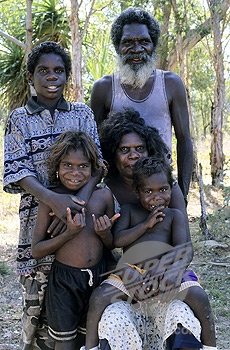
(5) Immediate Australian Aboriginal Family
1. Australian Law Reform Committee
n.d Aboriginal Marriages and Family Structures Marriage in Traditional Aboriginal Societies. Electronic Document, http://www.alrc.gov.au/publications/12.%20Aboriginal%20Marriages%20and%20Family%20Structures/marriage-traditional-aboriginal-societie, Accessed February 10, 2015.
2. Australian Law Reform Committee
n.d Aboriginal Marriages and Family Structures Marriages in Aboriginal Societies Today. Electronic Document, http://www.alrc.gov.au/publications/12.%20Aboriginal%20Marriages%20and%20Family%20Structures/marriages-aboriginal-societies-today, Accessed February 10, 2015.
3. Bourke, Eleanor
1993 The First Australians: Kinship, Family and Identity. Electronic Document, http://www.aifs.gov.au/institute/pubs/fm1/fm35eb.html, Accessed February 11, 2015.
4. Pattel, N.
2007 Aboriginal Families, Cultural Context and Therapy. Counselling, Psychotherapy, and Health, 3(1).
5. People Assisting Parents Association
n.d Origin of Australian Aboriginal People. Electronic Document, http://www.pa-pa.ca/Australia.html, Accessed Febuary 10, 2015
6. Smith, Stephanie.
2002 Aboriginal Benchbook for Western Australian Courts: AIJA Model Indigenous Benchbook Project.Carlton. Carlton: Australian Institute of Judicial Administration.
Sunday, February 8, 2015
The Past of Australia's Aborginals
The
definition of aboriginal is humans who existed in a continent before colonists
arrived. As stated in National Geographic magazine the Aboriginals were the
only inhabitant’s of Australia for over 50,000 years, but today they
account for less than 3 percent of Australia’s population. Aboriginals
are thought to be one of the earliest people to migrate from Africa to
Australia. During the 1700s the British invaded Australia bringing with them
diseases such as small pox, measles and venereal diseases. This caused the
aboriginal population to decrease rapidly. The British also forced the
Aboriginals off their land assuming they migrated from place to place. However,
what they did not know is that the Aboriginals are very spiritual about their
land, which weakened their cultural practices. The British also brought
livestock, which drove out a lot of the native animals that the Aboriginals
hunted for their survival.
From the
late 1700s to the early 1900s the aboriginal population decreased by over 90
percent. Many people thought the Aboriginals of Australia would become
non-existent. During the Australian Gold Rush in the 1850s Australian
Aboriginals became laborers for the British. Most of them did not receive pay
and instead were given food, clothes and other necessities. The Aborigines
suffered greatly from racism. Most Aboriginals were denied full citizenship
when the British colonized in Australia. It wasn’t until 1965 that all
Aboriginals of Australia were given the right to vote. During the 20th century
a large number of Aboriginal children were taken from their home and placed
with families in an effort to get rid of the Aboriginal Race. The Aboriginals
have dealt with a great deal of suffering in the past but the Australian
Government has made an effort to help the people that were once the only
inhabitants.

1700's British Invasion

Racism against the Aboriginals
Aboriginal Heritage Office
2006 Aboriginal History.
Electronic document.
http://www.aboriginalheritage.org
accessed 9 Feb. 2015.
Survival International
2013 Aboriginal People.
Electronic document
http://www.survivalinternational.org/tribes/aboriginals accessed
9 Feb. 2015
National Geographic
Magazine
2013 Aboriginal
Australians. Electronic document
http://ngm.nationalgeographic.com/2013/06/aboriginal-australians accessed
9 Feb. 2015
Subscribe to:
Posts (Atom)