
Aboriginal
family structure strongly relies on a kinship both in the past and today. They
have very close and strong family ties and relations which consists of not only
immediate family members, but extended family members as well (4). Family is of
utter importance in Aboriginal society, due to the belief that family and kin
members help each other in times of need as well as in dealing with the
discrimination and racism found in urban Australia (4).
Marriage
Traditional marriage in Aboriginal society consisted
of arrangements between two families, and interchanging a gift to solidify to
the agreement (1) . In addition to this, there was a
wide gap in age differences between the couple as well as many polygamist
relationships (6). However due to outside influences that came about with
European colonization, marriage beliefs has changed significantly. Marriage
today is different in a variety of factors however. For starters, agreements and
promises are not as forced and strong as that in traditional Aboriginal
society. Aboriginal females do not marry as young and actually marry a
“promised” husband after finishing and/ or leaving schooling. Because of this,
the age gap between couples has shrunk greatly. In addition to this, females can
resist a “promised” marriage and choose a husband of their own (2). Polygamy,
however has decreased greatly as well but not has entirely disappeared. Some
men in Aboriginal Kins do have second or third wives as they grow older (2). In a marriage however, a female does still
leave her biological kin and joins her spouse’s kin (4).
Roles
As stated before family is of utter importance in
Aboriginal Society and consists of both immediate and extended family members.
Unlike the nuclear family found in many areas of the world, Aboriginal family
dynamic differs greatly. Immediate and extended families often live together or
in extremely close proximity's (4).Child rearing also does not only consist of
individual parents caring and watching for a child. Often grandparents and other family members
are involved in child rearing and caring for the household (3). Caring for
children and the family is a role for every family member regardless of the
gender and age.
Now each gender and age has distinct roles in
aboriginal society as well. Older
children as well are often required to look after younger siblings and help in
the household or financially in this family dynamic (4). The elders are also
responsible in child care, but also responsible in providing passing and
maintaining cultural traditions. The elders, like in many cultures are viewed
as one of the wisest individuals in a kinship (3). Though gender differences and responsibilities
have changed, Aboriginal women do value child bearing greatly (3). They often
prefer a motherly position rather than a marital position and often can be
involved in outside of marriage child bearing (3). Men do gather and try to
sustain the family by hunting and fishing but the population of Aborigine men has declined due to mortality and high prison and criminal rates (3).
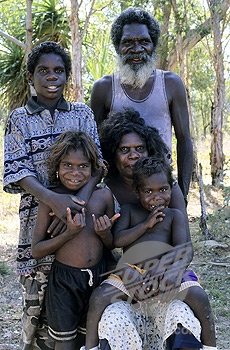
(5) Immediate Australian Aboriginal Family
1. Australian Law Reform Committee
n.d Aboriginal Marriages and Family Structures Marriage in Traditional Aboriginal Societies. Electronic Document, http://www.alrc.gov.au/publications/12.%20Aboriginal%20Marriages%20and%20Family%20Structures/marriage-traditional-aboriginal-societie, Accessed February 10, 2015.
2. Australian Law Reform Committee
n.d Aboriginal Marriages and Family Structures Marriages in Aboriginal Societies Today. Electronic Document, http://www.alrc.gov.au/publications/12.%20Aboriginal%20Marriages%20and%20Family%20Structures/marriages-aboriginal-societies-today, Accessed February 10, 2015.
3. Bourke, Eleanor
1993 The First Australians: Kinship, Family and Identity. Electronic Document, http://www.aifs.gov.au/institute/pubs/fm1/fm35eb.html, Accessed February 11, 2015.
4. Pattel, N.
2007 Aboriginal Families, Cultural Context and Therapy. Counselling, Psychotherapy, and Health, 3(1).
5. People Assisting Parents Association
n.d Origin of Australian Aboriginal People. Electronic Document, http://www.pa-pa.ca/Australia.html, Accessed Febuary 10, 2015
6. Smith, Stephanie.
2002 Aboriginal Benchbook for Western Australian Courts: AIJA Model Indigenous Benchbook Project.Carlton. Carlton: Australian Institute of Judicial Administration.

No comments:
Post a Comment